Facebook launched the new page layouts on the 10th of March to bring the ‘Pages’ design in line with Profile pages. The two biggest changes to note are that tabs have moved to left hand side, and there are now a selection of images across the top.
Static FBML is now being phased out in favour of Facebook Apps, which means you can build apps with HTML, CSS and Javascript using the Javascript SDK, or with PHP, CSS and Javascript using the PHP SDK. These files are hosted on your own server and then pulled into Facbook via an iFrame.
http://developers.facebook.com/docs/guides/canvas/
These new apps provide a platform for amazing new opportunities. You can now create a mini website and ‘pull’ it into Facebook giving you the design flexibility of a bespoke website combined with the marketing and social networking advantages of Facebook. Static FBML has been around for a while and we have used it successfully for clients here at What!? It was great for enhancing pages with custom tabs, however as the content had to be static it greatly restricted the potential scope of projects.
Facebook apps allows you to create fully fledged dynamic PHP pages that can do any number of things. You can pull content from a database, or even use JavaScript to add extra interactive elements. The only major restrictions are the page widths:
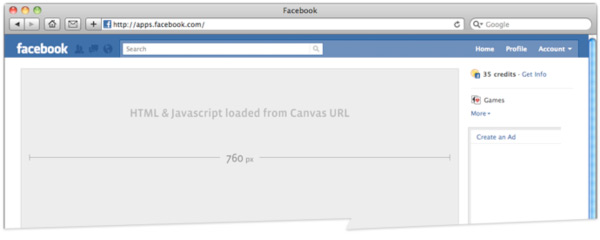
Canvas Apps sit within Facebook at a width of 760px
Canvas Tab Apps sit within Facebook at a width of 520px
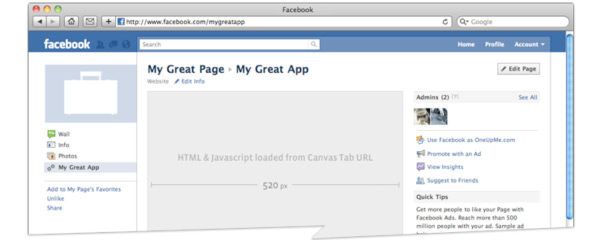
Note: As many apps are longer then the users’ browser window, make sure you leave space for a scroll bar. This reduces width of Tab Apps to 480px.
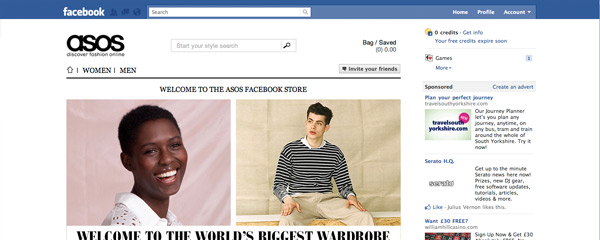
The ASOS application is a great example of how powerful apps can be; Their e-comerece shop is built right into Facebook: http://apps.facebook.com/asosofficial/.
The Ribena sign-up tab is a great example of a Flash tab with custom content depending on whether or not you’ve ‘Liked’ the Page or not: http://www.facebook.com/RibenaUK?sk=app_196456090374786
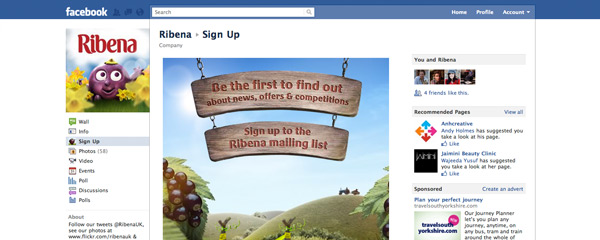
You can easily show and hide content depending on whether a user ‘Likes’ your Page, just as you could with static FBML. Rewarding users with content is a great method of increasing your fan base and encourage users to engage with your company.
However, over and above all of these fantastic advantages, in my opinion the strongest new feature is the option to access and interact with a user’s profile. You can access their user name, location, status, you can uploaded photos, publish information to a user’s stream, create events, and much more. (There is a full list of permissions is available here: http://developers.facebook.com/docs/authentication/permissions/)
Having said that, of course the user has to grant you access, which is a good thing (especially considering Facebook is forever getting in trouble when it comes to peoples information - they don’t seem to like the word ‘Privacy’ very much).
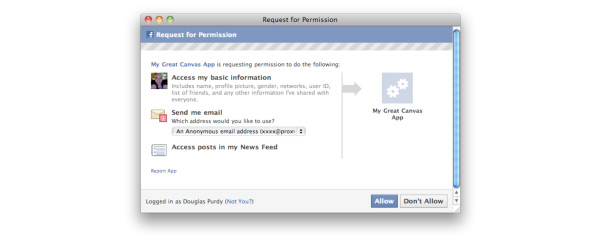
When a user sees the ‘Request for Permission’ window it lists out all the information that your app wishes to gain access to, and they have the option to either allow or deny access.
Being able to deliver custom content can really enrich your application as well as help the user by automatically filling in forms or showing them their nearest retail store (using the user_location permission). From a marketing point of view being able to access this information is excellent, you can deliver (more or less) exactly what the user wants!
Delivering custom content is a great tool but your app can also post information to a user’s feed. That might not sound like much, but the marketing potential is amazing! Your product or brand will appear in a user’s feed, which providing some of their friends also ‘Like’ your application, it will in turn appear in all their friends’ feeds, and then in their friends’ friends’ feeds, and so on, and so on.
Facebook has over 500 million active users and people spend over 700 billion minutes per month using the website - now that’s a hell of a lot of free exposure. Facebook is becoming the new portal for the Internet and more and more companies are listing their Facebook address instead of their website URL on TV adds and in other media. The number of features and marketing opportunities that are now available begs the question: ‘Is the mircosite dead?’
Like the sound of a Facebook app? Get in touch whether your a company or an agency because we would love to work with you!
By Chris Kemm