Let me introduce myself, I’m what you call “a user”
So, you might be thinking this is something of a contrived statement? One that is to lead on to an article full of humorous wit and intrigue, maybe with a twist! Well, I’m afraid such an assumption may lead to nothing more than bitter disappointment. But hold on and wait just a moment longer, there is a reason for doing so.
Okay, let’s get down to the nitty-grit, the nuts and bolts, the crux, the real reason why we’re all here.
Your latest site build has gone live – it’s looking good, it’s on-brand, it’s ticking all right the boxes, it’s a master piece of modern art, a real winner. The analytics figures are beginning to come through and traffic is hitting the site in huge numbers… It’s looking like a massive success, the client is going to be ecstatic, joyous beyond all belief. You’ve got them now; a roaring success and new business will indeed be yours for the taking.
But wait… What’s this?
The traffic and conversion figures are not adding up. We’ve got tens of thousands of people hitting the site but the exit rate is almost the same – no conversions, nothing!
What the heck is going on?
Why is this happening?
Oh, oh… How am I going to explain this to the client?
That sinking feeling has hit, and it hits hard. It’s looking like a classic faux pas. Having been so desperate to appease the client with the promise of increased traffic rates and a nice shiny new site, the whole ‘point’ of it has been well and truly missed - side-stepped if you like!
So to reiterate the title… Let me introduce myself, I’m what you call “a user”.
In fact we’re all users, and as a user I’ve arrived at the aforementioned shiny new site with intent. Be it through prior knowledge of your product or service, or from natural search, PPC, a banner ad maybe or possibly via a supporting off-line media campaign. Either way, I’m here and I’m ready to invest my time in you and your brand.
But where do I go and what do I do next? What makes your company different to all of the others out there? What mindset am I in and where should I click next? It really doesn’t take long for frustration to set in, and before you know it the chances are I’m off elsewhere. Off as in I’ve just exited the site, maybe a click or two later after a desperate attempt to make sense of the whole debacle – but I’ve gone… My journey has come to an end and Elvis has indeed left the building!
At this point you may be thinking that such a scenario would never happen, surely the extensive media planning together with the adoption of user centered design principles, and the vast swathes of analytical data along with the creative nuances and exquisite copy that have helped forge a site that will captivate, inform and convert.
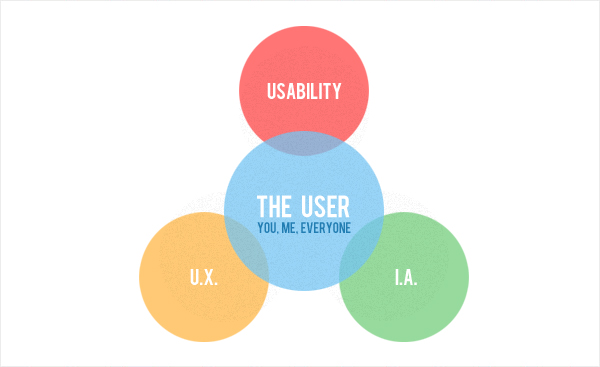
Well in this particular scenario it didn’t, because the leading principle of designing for the user never happened. And by and large this can be broken down into a number of constitute parts:
- Usability
- User experience design
- Information architecture
Each of which have their own reliance on prior knowledge and research so as to ensure the best possible solution is provided to the client, which will in turn maximise reach and ultimately deliver a successful project.
The usability aspect is about being able to convey the site in such a fashion that the user instinctively knows what interactions are required of them in order to ‘use’ the site. It may sound obvious, but usability is so often overshadowed and in extreme cases it may actually render the site as being unusable.
Whereas the user experience (UX) isn’t restricted to just the online world, it covers a whole plethora of mediums and rallies the need to ensure the user experience, regardless of medium, is consistent and affects their perception of the company, the ‘brand’, its products and its services in a positive manner. It is also in-place to relay the language used across each medium to be one that is familiar and coherent to the expected audience – time to drop the corporate line and remember whom we’re actually talking to!
Information architecture, or IA if you will; a user doesn’t care as to how a site is structured, or indeed as to how elements are placed on the page. But if the IA isn’t implemented correctly then the said same user will care. They’ve already chosen to engage in what is in-effect a foreign environment, and within this environment if the information of interest to them isn’t readily available, or the navigation points are lost through ‘noise’ then the risk of them remaining on the site is reduced significantly.
In essence this is what user centered design (UCD) aspires to capture. Adopting UCD increases usability, with usability being a close relation to the successful implementation of information architecture, whilst maintaining the focus of the experience across all channels.
It’s psychology, understanding the needs and anticipating the journey of your users who are your audience, and ensuring they can obtain the required information quickly and easily. Doing so raises the probability of successful conversion and future engagement, be it return visits or further brand engagement through other channels.
We need to help users perform their tasks through the construction of on-page information, ensuring they are able to deconstruct and interpret what and where they need to go in a less problematic fashion.
One could even say this is a common sense approach; such a shame that it’s so often dismissed in favour of creative flair minus the science.
So there you have it. I’m a user, you’re a user – and with that in-mind, let us never lose focus of…
The user!
By Mark Bateman